
From Intelligence to Impact: The AI Agentic Era
April 15, 2026
Dear Friend,
In the time it takes to write this newsletter, the AI landscape shifts again. That is the reality of covering a field evolving at breakneck speed and why capturing this moment matters. Howard Marks, one of the investors we most admire, recently addressed this in his memo AI Hurtles Ahead (www.oaktreecapital.com/insights/memo/ai-hurtles-ahead), sharing both his hands-on experience and his concerns about AI tools. If you are less familiar with AI terminology, his writing offers valuable context.
Amidst this rapid evolution, geopolitical developments, including the conflict in Iran, have contributed to recent market volatility. In investing, this is not simply noise; it is opportunity. While these developments matter, our focus remains on the AI trends that we believe will shape lives and investment outcomes for years to come.
February introduced OpenClaw, an autonomous AI agent capable of mimicking human workflows. It can complete tasks, reason through obstacles, and deliver intended results. More remarkably, AI agents can review and improve their own source code. Humans can communicate instructions with AI agents through a simple messaging app, much like giving commands to a real person. If hardware capacity allows, users can run multiple projects simultaneously across various AI agents, 24/7. As these capabilities continue to evolve, their practical applications are becoming increasingly tangible. Some have proposed deploying AI agents to audit COBOL code—an older programming language that still underpins many banks, airlines, and government systems—to identify errors and correct them. The task would deliver tremendous productivity gains in record time. Only a few years ago, this would have been considered science fiction. Now, human imagination is beginning to lag behind AI’s capabilities.
Recent model releases, including Google’s Gemini 3, Anthropic’s Sonnet 4.5, Opus 4.6, and Cowork; and OpenAI’s GPT-5.3-Codex, have sparked concerns around white-collar job loss, particularly in entry-level positions. We are already observing early signs of this shift.Many IT companies are reducing software engineering headcount. Experienced engineers are now leveraging AI to handle lower-level coding, bypassing junior hires entirely. This creates a longer-term paradox: the very jobs that traditionally trained the next generation of talent are disappearing, potentially creating a skills gap at senior levels years from now. The threat even extends to enterprise software companies that provide knowledge-based services. In our opinion, the threat is real and present. However, the rate of adoption will ultimately depend on decision-makers’ comfort with security, governance, and broader societal impact.
While software-based AI agents are transforming knowledge work, the physical world represents the next frontier. Years ago, when we discussed aging populations, robotics was theoretical. Today, robots can dance and perform complex tasks with increasing precision and consistency, and we barely blink.
As robots learn from and transmit real-world data about their surroundings, their capabilities will expand to roles that no human would dare or be able to do. This has meaningful implications: supporting aging populations, assisting in recovery and care, and performing tasks that are difficult, repetitive, or unsafe. The integration of robotics technology is becoming a practical solution to many of these challenges, and it is now within our reach.
AI Model Monetization Opportunities
We hear constantly about hundreds of billions in AI spending, but less about how companies will recoup those investments. This concern fueled market volatility earlier this year. We see three ways to monetize AI models: charge for intelligence, recommendations, or outcomes.
Some AI models have explored displaying advertisements during use. In our view, this approach is outdated. It follows the search engine playbook and diverts users from their intended workflow. Unlike search, where users expect to browse and compare options, AI is designed to complete tasks. Interrupting that process with advertisements reduces productivity and undermines its core purpose.
As AI enters an exponential growth trajectory, we expect the first two monetization methods—intelligence and recommendations—to become increasingly commoditized. Over time, value will shift toward outcomes and execution. Why? Because intelligence alone has no inherent value. It is what that intelligence enables that matters. An AI system that writes code is useful. One that deploys, monitors, and corrects that code autonomously becomes far more valuable.
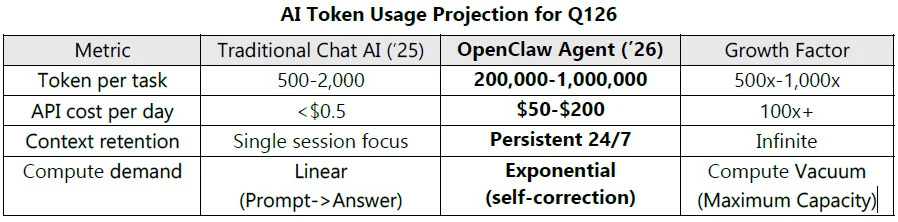
With this in mind, readers should understand why the introduction of autonomous AI agents is critical to the broader AI ecosystem, as it ties commercial transactions directly to the value AI provides. Monetization can now be based on usage through tokens, linking cost directly to outcomes.
Tokens can be thought of as the currency of AI; they are the units of text that models process. Every query, response, and line of code consumes tokens, which is why growth in token usage translates directly into computing demand and cost. Please refer to the tables below to see the impact of the agent application on AI token usage and internet bandwidth. (Sources: Cloudflare and Akamai, summarized by Gemini)

Investment Focus
I asked Gemini’s Nano Banana, a picture-rendering AI tool, to create an image showing recent investment focus topics. As you can imagine, the time and skill required to produce a comparable image manually is tremendous compared to using AI. Gemini created the picture below in just seconds.
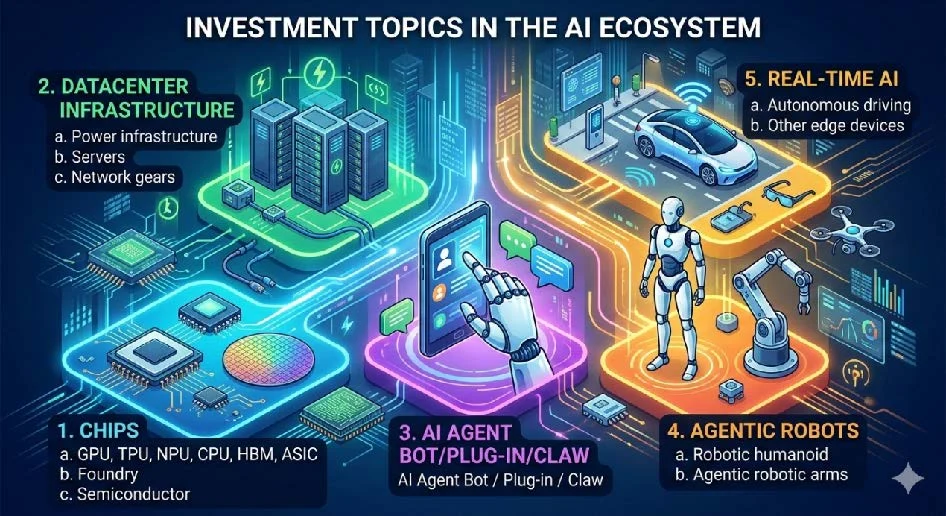
Our investment thesis remains consistent: this immersive ecosystem offers multiple entry points. Some companies are direct beneficiaries, while others provide the critical infrastructure, components, and services that enable AI platforms, data centers, and end devices. With the AI infrastructure theme getting long in the tooth, we must adjust our portfolios for the next phase of development.
Looking three to five years ahead, which AI adoptions will materialize? Which current investments face obsolescence? And beyond AI pure plays, what businesses remain essential? Our predictions are these:
1. Oligopolies will form across AI infrastructure, including models, chips, servers, and foundries.
2. We anticipate an explosion of AI-enabled devices across personal, business, and government contexts. Your next car will not only have navigation—it will have an AI agent that knows your schedule, reroutes you around conflicts, and books appointments when you are running late.
People will become accustomed to using AI whenever and wherever they need it, just as they now expect Wi-Fi or internet access almost anywhere, from airplanes to underground transit systems, and even in national parks.
3. Enduring investments will serve basic human needs and desires. An AI-abundant world lets us work more efficiently and spend more time living.
Risks and Constraints
When everyone fights for the same resources, such as AI chips and energy, shortages are inevitable. Since the start of the pandemic, the risks in semiconductor supply chains—particularly the concentration of manufacturing capacity and location—have been well known and widely discussed. It will take years for the supply chain to diversify to an acceptable level for its main buyers. While the process of reshoring capacity has begun in the United States, Japan, and Germany, it will not be easily accelerated.
Capital can move quickly. Talent and infrastructure cannot. Developing a skilled workforce and addressing environmental issues will require long term governmental planning and policy coordination at both the national and local levels, processes that are inherently slow and difficult to execute.
Those mighty AI models ultimately run on electricity, and Earth’s current supply is finite, barring a breakthrough in space-based energy. Due to energy constraints, the number of clear winners in the AI race will be limited. Hence, the fight for stable energy supplies is likely to become an increasingly geopolitical issue in the AI world. Countries with excess energy capacity are positioned to become AI powers, while those without may find themselves dependent on others for access to intelligence.
Perspective from Taiwan
This was reinforced during a recent visit to Hsinchu, where I was born and where Taiwan Semiconductor Manufacturing Company (TSMC) is headquartered. The scale of development across the industrial parks was striking. Seeing the concentration of fabrication facilities, suppliers, and ongoing construction made clear how central this region is to the global semiconductor supply chain.
The visit also highlighted a broader point: the AI revolution is not only driven by software advances, but also by highly specialized manufacturing infrastructure that takes years to build and scale. Without Hsinchu, and without TSMC, the pace of AI advancement as we know it today would not be possible.
Conclusion
The key to intelligence is learning. At Noesis, learning is both our name and our discipline. We built the firm around that truth. Learning to deploy AI to enhance productivity, reduce redundancy, and improve accuracy will be a near-term priority across industries. While letting go of familiar workflows is scary, the opportunity to work alongside super-intelligent technology should be exciting—and rewarding.
We will discuss AI again soon, likely in a new format, whether through a podcast, video, or a virtual world that requires a VR headset. Imagine pausing content to ask questions and receive immediate answers. In the world of AI, imagination may be the only limit. For our clients, that imagination extends to how we position your investments to capitalize on the opportunities ahead.
Sincerely,

Shihfang Chuang